
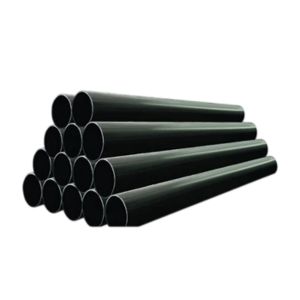
When water freezes solid in an HDPE pipeline, will it damage the pipe? How is it most effectively thawed?
No, HDPE pipe will not rupture or burst when water freezes solid inside it — the pipe simply expands with the ice due to its flexibility. To thaw it safely: Apply heat carefully to avoid damaging the pipe. One effective method is heat tracing — wrap the frozen section with pressure-sensitive metallic tape (to spread heat evenly), then add temperature-limited heat tracing tape (max 120°F). Heat blankets are another good option. Never use open flames, torches, or arc welders. Always consult the pipe manufacturer for recommended thawing methods.
What percentage of external surface scratching or scarring is allowable on HDPE pressure pipe?
Minor scratches or scuffing do not affect performance. Scarring or gouges up to 10% of the pipe’s wall thickness are generally acceptable. Anything deeper than 10% should not be used.
Is it possible to puncture HDPE pipe; how is that repaired?
Small-diameter HDPE pipes (typically under 6 inches) can sometimes be severed by excavation equipment. Larger diameters are much harder to puncture — damage more often appears as kinking rather than holes, since excavators struggle to grip or penetrate thick walls. Repair options:
- Small punctures: Use electrofusion patches.
- Larger damage: Cut out the damaged section and insert a spool piece, connecting it with mechanical fittings, flange adapters, or electrofusion couplings.
- Temporary fix: Full-circle clamps can be used in some cases. Consult the pipe manufacturer for the best approach based on damage size and location.
How is HDPE pipe repaired without the use of heat-fusion?
Use mechanical fittings — many types are available and perform well for repairs. For best results, combine them with stainless steel insert stiffeners and restrainers to ensure a secure, leak-free connection. Check with the pipe manufacturer for suitable fittings.
How do I repair HDPE pipe if the ditch is full of water?
If possible, dewater the ditch and dry the pipe so heat fusion repair can be used. Otherwise, go with a mechanical repair method, which doesn’t require dry conditions.
What are some applications where an insert stiffener is required?
Insert stiffeners are commonly needed when:
- Inserting HDPE pipe into a PVC bell or ductile iron mechanical joint (MJ) bell — to ensure proper gasket compression.
- Using most mechanical fittings.
- Using MJ adapters on pipes larger than 12 inches (to prevent deformation from thermal contraction or gasket pressure).
Can I use a butterfly valve on HDPE pipe?
Yes — but check the valve dimensions first. Some butterfly valves require special flange adapters or tapered spacers so the disc can open and close freely without interference. Consult your flange or mechanical joint adapter supplier to confirm compatibility.
Can I pig HDPE pipe?
Yes, pigging is possible, but use a soft pig to avoid damaging the pipe’s smooth interior surface.
AUTHOR BIO:

Endy Gunawan is the Director at Kharisma Group and holds a degree in Engineering, which provides the technical foundation for his expertise in complex infrastructure. He specializes in providing integrated solutions for industrial piping, prefab steel structures, and water storage systems. Endy is dedicated to driving innovation and excellence across Indonesia’s industrial landscape, ensuring that engineering precision meets strategic growth. For project inquiries or professional networking, connect with Endy Gunawan on LinkedIn