
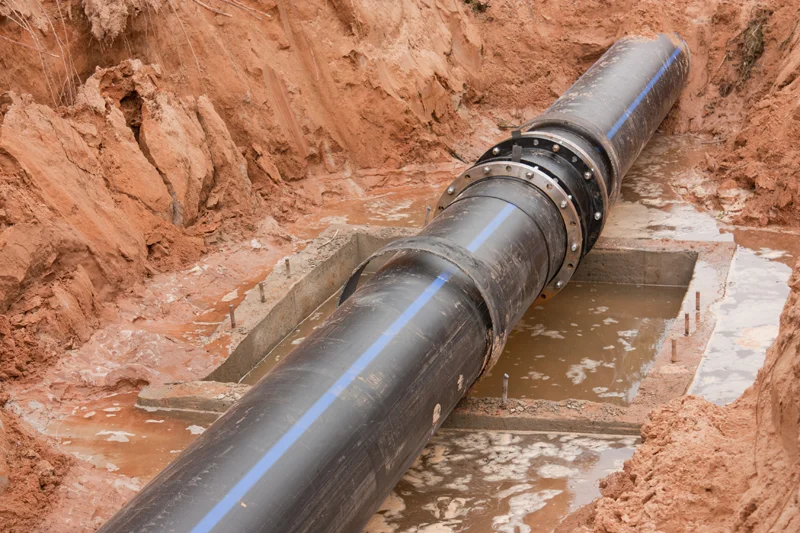
How deep can HDPE pipe be installed?
Depths vary by project and should be calculated. As a guideline, many HDPE pipes can handle cover from just a few feet up to over 100 feet (e.g., in landfill applications), depending on soil, loads, and pipe DR.
Are backfill procedures different for HDPE pipe compared to PVC pipe?
No — both are plastic pipes and use the same standard backfill and embedment procedures. Proper support and compaction around the pipe are key for both. Thinner-walled (higher DR) pipes under shallow cover with heavy live loads (like traffic) may need higher compaction levels than stiffer (lower DR) pipes. Always follow the HDPE pipe manufacturer’s installation guidelines.
Does HDPE pipe require cathodic protection? Can it be installed in “hot” soils that attack metal pipe?
No cathodic protection is needed. HDPE does not corrode from galvanic action like metals do, so it can safely be installed in aggressive (“hot”) soils that would damage metal pipes.
Are thrust blocks required with buried pressurized HDPE pipe?
No — not when the entire system uses heat-fused joints. Fully fused HDPE is self-restraining. Thrust blocks are only needed if gasketed mechanical fittings are used (similar to PVC or ductile iron systems).
What is the allowable bending radius of HDPE pipe? How does it compare to PVC pipe?
HDPE can be bent much tighter than PVC — for the same size, HDPE’s bending radius is about 1/10th that of PVC. HDPE allows safe cold bending (long-term) based on DR:
- Lower DR (stiffer pipe) = tighter allowable radius. Exact values vary by manufacturer, but HDPE is very flexible. During installation (short-term), even tighter bends are often possible. Check manufacturer tables for specific limits.
How are HDPE pipelines located after burial?
Install a tracer wire (metal) directly above the pipe during installation — this makes future location easy with standard locators. If no tracer wire was used, locate with ground-penetrating radar (GPR) or acoustical methods.
What are the recommended procedures to pressure test an HDPE pipeline?
Follow PPI and ASTM guidelines specifically for polyethylene pipe (different from bell-and-spigot pipes like PVC or ductile iron, which allow some leakage; HDPE allows for thermal expansion instead). Use hydrostatic testing per ASTM F2164 (“Standard Practice for Field Leak Testing of Polyethylene Pressure Piping Systems Using Hydrostatic Pressure”).
Compared to the host pipeline, what diameter HDPE pipe should be specified for sliplining?
As a general rule for pipes up to 24 inches: Choose an HDPE liner with an outside diameter about 90% of the host pipe’s inside diameter. For larger sizes: Aim for the host pipe’s inside diameter to be about 2 inches greater than the HDPE liner’s outside diameter. This varies based on deflection, sags, bends, obstructions, etc. Always analyze the specific project.
In sliplining and pipe bursting, is there another way to stop groundwater tracking at manholes besides chemical grout?
Yes — use a link seal or water stop (puddle flange) combined with sealing grout where the HDPE pipe enters/exits the manhole. These create a watertight seal between the pipe and grout, preventing seepage.
Must the entire annular space be grouted when sliplining with HDPE pipe for a water pressure application?
Not usually. It depends on factors like internal operating pressure vs. external loads (earth, groundwater, traffic). Grouting the ends/termination points is common for pressurized systems, but full annular grouting is rarely required. Always have the design engineer analyze the specific conditions.
Are there guidelines for the maximum length of HDPE pipe that can be pulled along the surface after fusing sections together?
Yes — the limit keeps tensile stress within safe levels for the pipe material and conditions. Maximum pull length depends on:
- Pipe’s tensile strength and weight
- Temperature during pulling
- Pipe dimensions
- Surface friction Using pipe rollers reduces friction and allows longer pulls. Use accepted equations to calculate it. Key input: tensile strength from the manufacturer’s data.
AUTHOR BIO:

Endy Gunawan is the Director at Kharisma Group and holds a degree in Engineering, which provides the technical foundation for his expertise in complex infrastructure. He specializes in providing integrated solutions for industrial piping, prefab steel structures, and water storage systems. Endy is dedicated to driving innovation and excellence across Indonesia’s industrial landscape, ensuring that engineering precision meets strategic growth. For project inquiries or professional networking, connect with Endy Gunawan on LinkedIn